A Success Story in Condition Monitoring
A Success Story in Condition Monitoring – Why Is Reliability So High at Corex?
Corex’s Pori mill has a long history, as the company—owned by the W. Rosenlew family—was founded as early as 1853. Over the course of the paperboard mill’s more than 100-year history, a wide variety of technical solutions have been implemented. Old and new technology work together, and the Pori mill’s annual cardboard production capacity is currently 130,000 tons.
“It adds a whole new dimension when a mill has such a long history,” says Jukka Majuri, Corex’s maintenance manager. The paperboard mill operates about 355 days a year; production usually stops only for Christmas and Midsummer.
The maintenance team’s goal is to keep unplanned downtime below one percent of the mill’s operating time. This means that with the machines running about 8,500 hours a year, the target level for unexpected disruptions is just under 85 hours. Nevertheless, in 2022, Corex achieved a figure of 50.9 hours, well below one percent.
A disruption always results in lost revenue in production
– If equipment breaks down on a farm, for example, the work can be done the next day. The same applies to industries that do not operate continuously. There, they can work a longer shift the next day to fix the problems. At a paper mill, where the machines run around the clock, a disruption always means lost production, Majuri points out.
Therefore, it is important for the machines to stay running without interruption. In 2019, Corex launched an SFK operational reliability agreement, under which, among other things, the condition of the equipment is continuously monitored.
– Monitoring improves performance and productivity. We can measure, for example, temperature or bearing vibration.
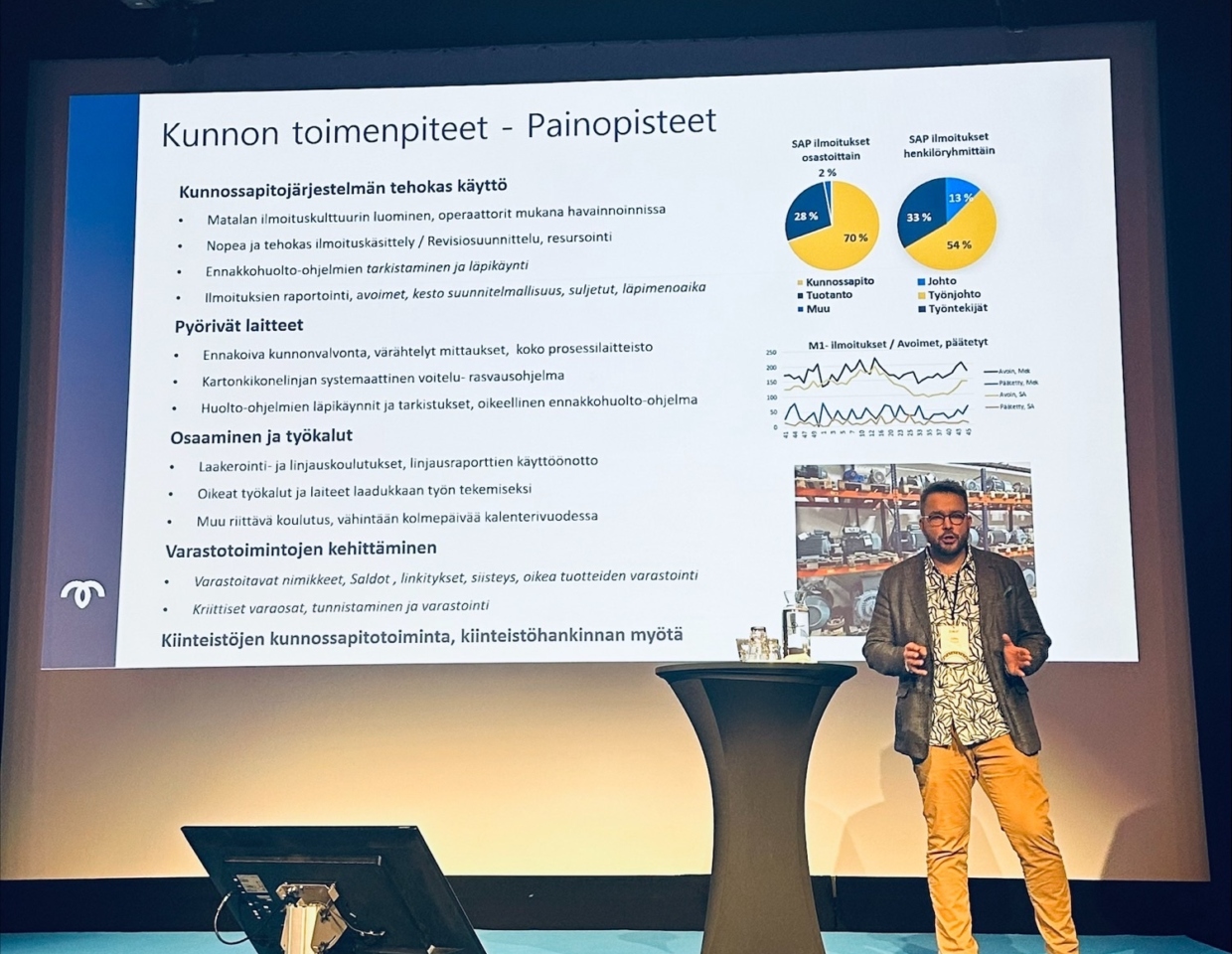
There are many things to measure, but Majuri also considers the observations of operating personnel to be very important.
– They can let us know if a machine is making a strange noise or if, for example, elevated temperatures are detected, allowing us to respond quickly.
With a service level agreement, equipment is monitored proactively, and the measurements trigger an alert at a low threshold if something appears to be malfunctioning. By performing maintenance work to a high standard, equipment can also be operated at higher and more consistent levels, improving the performance of the entire process.
Condition Monitoring – Proactive Condition Monitoring Improves Operational Reliability
Thanks to extensive maintenance, Corex has significantly improved its uptime. In 2022, downtime dropped significantly compared to previous years, with only 50.9 hours of downtime recorded that year.
Proactive condition monitoring measures have been implemented to cover the entire production line. A systematic lubrication program for the paperboard machine, vibration measurements of the entire process equipment, and staff training are all measures aimed at improving condition. Improvements can also be made by lowering the threshold for reporting even minor observed changes.
In addition to reducing downtime, condition-based measures have improved safety, for example by reducing the risk of fire. This has also made it possible to increase productivity and better serve customers.
“If even a single part of a machine malfunctions, we can’t serve customers at the same pace,” Majuri points out.
Not everything can be measured and predicted
As companies become better at avoiding disruptions, their financial performance improves. The fewer disruptions there are, the better a company performs. However, even the best metrics cannot predict everything.
“For example, the failure of an electrical component usually cannot be predicted. If a fault occurs suddenly, it cannot be detected through measurement, even if the process is under control,” says Majuri.
The Corex plant operates 400 complex rotating machines of varying ages. For example, part of the board machine was built as far back as 1958.
“When a single piece of equipment stops, the production line can come to a halt immediately. If a failure occurs on the recycled pulp production side, we have a maximum of three to four hours to fix it. On the cardboard line, however, a fault brings everything to a halt. That is why it is extremely important to follow condition monitoring procedures. The plant’s operational efficiency is also important in terms of its central location and the environment. “Functioning machines are part of our competitive edge,” Majuri sums up.